Game Designer – Digital Tales
Overview
Venetia 1100 A.D. was a narrative driven game. The player wears the clothes of Rainardo, a young amanuensis monk who needs to solve the mysteries that envelop the city of Venice.
Set in the XII century, Venice is not the romantic city we all know, but a dark and swampy place, with many wooden houses that would often catch fire.
This project was scrapped just after I left Digital Tales.
I worked on:
- Level Design
- Layout schemes
- Implementation in Unity
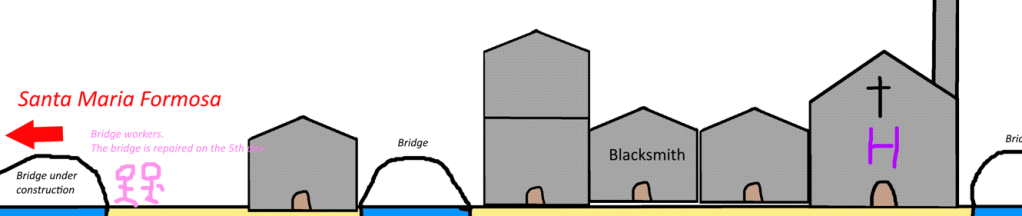
- Event Timelines
- Flow charts
- Timeline depicting the exact moment and durations of events
- Implementation in Unity
- Dialogue structure optimization
- Faster to write for the writers
- Reduced duplication of content
- Main game mechanics
Gameplay
The gameplay is very story focused. The player can move around the city of Venice by controlling the main character with a side view camera. There are some platforming elements but they are not the main focus.
Everything happens in real time. The length of a playthrough is 4 in-game days (~12 minutes a day), after which the game restarts. The player can see the NPCs moving around the city and can learn what they are doing and act accordingly.
With each playthrough the player can learn new information about the mysteries, the plot and about what happens in general in the city.
Multiple playthrough are needed to complete the game.
There are 4 main mysteries. To access the True Ending the player needs to complete all 4 of them in a single playthrough. It sounds hard but once the player has all the information needed, solving each mystery is quick and easy.
Information gathered in previous playthrough is stored in a journal.
The fact that the character retains memories from a previous playthrough is explained by the fact that the story is not unfolding in real time. We are actually witnessing Rainardo, in his old age, who is writing his memories of those days and is trying to recollect what happened. What we are playing is basically what happens in his mind while he writes.
After a Bad Ending we can see him complaining about his memory because that’s not how the real story unfolded, so he needs to try again.

 Alberto Arosio